Last updated September 2026.
Opening a bank account is one of those jobs that quickly moves up your to-do list when you arrive in Iceland. The good news is that opening the account itself is not necessarily the difficult part.
For newcomers, the bigger issue is usually having the right identification in place first.
In practice, a kennitala – your Icelandic national ID number – is usually the key first requirement. Electronic ID can then make opening and using your account much easier, particularly if you want to do everything digitally.
But electronic ID is not necessarily required for every route. Some banks offer an in-person option if you do not have it yet.
Here’s how the process works.
Who’s this for?
This guide is for people preparing to move to Iceland or who have recently arrived, including:
- EU/EEA/EFTA nationals
- People moving from the UK, US, Canada and other non-EEA/EFTA countries
- International workers
- International students
- Newcomers who already have a kennitala but have not yet opened an Icelandic bank account
The exact process can differ depending on your immigration status, the identification you hold and the bank you choose.
What do you need to open a bank account in Iceland?
Requirements vary, but you may need:
| What you may need | Why it matters |
|---|---|
| Kennitala | Usually the main Icelandic identifier required to open an account |
| Passport or accepted ID | To verify your identity |
| Residence permit, where applicable | May be required for applicants from outside the EEA/EFTA |
| Electronic ID | Often used for digital account opening and banking |
| Contact details | Your phone number, email and address |
| Employment and income information | May be requested as part of the bank’s checks |
| Source-of-funds information | Used for standard customer due-diligence requirements |
Iceland’s official government portal says a national ID number is needed for a wide range of services, including opening a bank account.
In practice, therefore, a kennitala is commonly required to open a standard Icelandic bank account.
Exactly what else you need depends on the bank and your circumstances.
Can you open a bank account before moving to Iceland?
Possibly – but don’t build your moving plans around it.
Opening a standard Icelandic personal account before your Icelandic identification and registration are in place can be difficult.
Usually, the issue isn’t simply that you are outside Iceland. It is whether you already have the identification and documentation the bank needs.
For most newcomers, that starts with the kennitala.
So if you are still preparing for your move, plan for a short transition period.
Keep your existing bank account open. Make sure your cards will work internationally. Check that you can still access your banking app and receive security codes after you leave your home country.
A multi-currency service such as Wise or Revolut can also be useful during this period – particularly for moving money between countries or covering everyday spending before your Icelandic account is fully operational.
What is a kennitala?
If you’re moving to Iceland, you’ll hear the word kennitala very quickly.
It is a unique ten-digit national identification number used throughout Icelandic administration and everyday life.
You’ll encounter it when dealing with government services, employers, banks and plenty more besides.
For EEA/EFTA nationals, a kennitala is generally obtained through the relevant registration process with Registers Iceland.
For many people from outside the EEA/EFTA, it is issued as part of the residence-permit process.
The exact route depends on your circumstances, so don’t assume that every newcomer follows precisely the same process.
What about a system ID number?
This is where things can get slightly confusing.
Iceland can also issue a system ID number in certain circumstances, including to some EEA/EFTA nationals working in Iceland for shorter periods.
A system ID number is not the same as ordinary registration in the National Registry and does not grant the same rights as a standard kennitala.
If you have been given a system ID rather than a standard kennitala, check directly with the bank which services you can access.
This can be particularly important when it comes to electronic identification.
What is electronic ID?
Electronic ID – rafræn skilríki – is widely used in Iceland.
It allows you to prove who you are digitally when accessing services such as online banking and government portals. It can also be used to approve transactions and sign documents.
For newcomers, it can make life considerably easier.
There are two forms worth knowing about.
Electronic ID on a SIM card
SIM-based electronic ID is stored on your phone’s SIM card.
This option requires an Icelandic phone number and a compatible SIM.
However, Auðkenni is now encouraging users to move towards its newer app-based electronic ID.
Electronic ID through the Auðkenni app
The Auðkenni app works over an internet connection and is not tied to an Icelandic SIM or phone provider.
If you have a valid Icelandic passport or Icelandic ID card and a suitable NFC-enabled phone, you can register yourself in the app.
Most newcomers will not have an Icelandic passport or ID card when they arrive. In that case, Auðkenni says you can instead visit an authorised registration point with accepted identification and have electronic ID activated in the app.
You will need an Icelandic kennitala to obtain digital ID through a registration authority.
And importantly, electronic ID is not always a prerequisite for opening the bank account itself.
Some banks provide an in-person route for customers who do not have electronic ID yet.
Which banks can you use in Iceland?
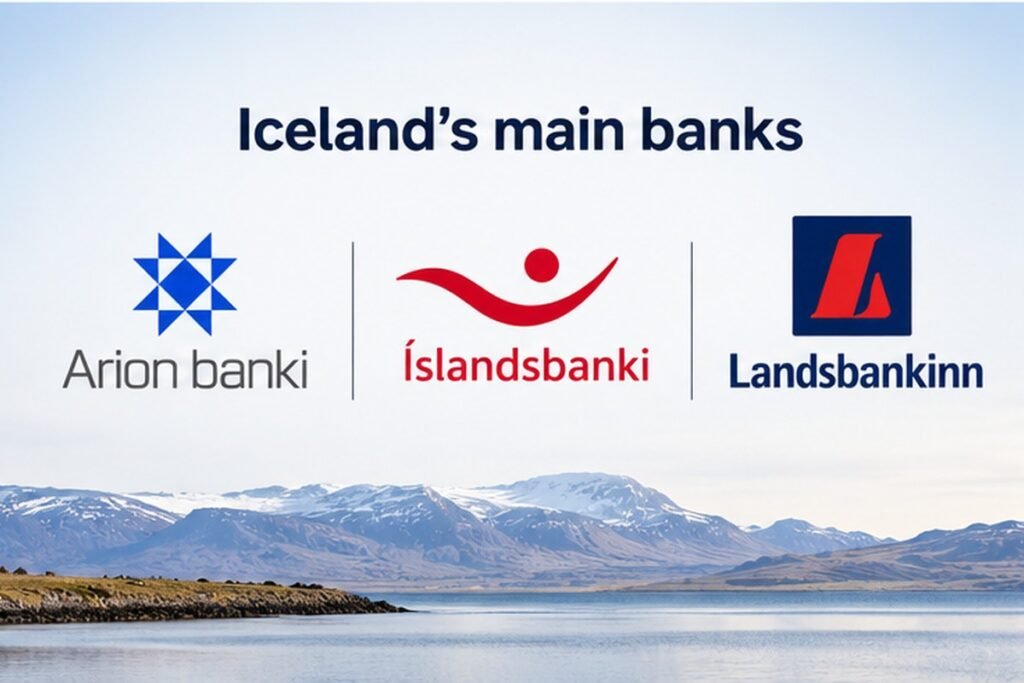
The three main retail banks you’re likely to encounter are:
Arion Bank
Arion offers personal banking through its app and online services.
If you have a kennitala and electronic ID, you can use the Arion app to establish a banking relationship, open an account and apply for a debit card.
Arion also provides an alternative route for people without electronic ID.
Íslandsbanki
Íslandsbanki offers digital account opening using electronic ID.
If you do not have electronic ID, you can apply for a bank account through a branch and bring your passport.
Customers from countries outside the EEA/EFTA are also currently required to provide a residence permit.
Landsbankinn
Landsbankinn allows new customers to sign up through its app or online service.
Its app supports electronic ID and the Auðkenni app. If you cannot complete the electronic-ID process yourself, Landsbankinn also directs customers to branch assistance.
Which bank should you choose?
You probably don’t need to overthink this.
Compare the things that will actually affect your day-to-day life:
- Account fees
- Debit-card fees
- Mobile banking
- English-language support
- Branch access
- International transfers
- Foreign-exchange charges
- ATM fees
Bank products, fees and onboarding processes change, so check the current information from each bank before applying.
How to open a bank account in Iceland – step by step
Step 1: Obtain or confirm your kennitala
For most newcomers, this is where the process starts.
If you don’t yet have a kennitala, complete the registration process appropriate to your circumstances.
If you already have one, make sure your details are correct.
You’ll need your kennitala for plenty of things beyond banking, so it is worth sorting out as early as you can.
Step 2: Get electronic ID if you’re using digital onboarding
If you want to open your account digitally, electronic ID will often be the easiest route.
Depending on the identification you hold, you may be able to activate the Auðkenni app yourself or may need to visit an authorised registration point.
If you don’t have electronic ID yet, don’t assume that means you cannot open an account.
Check whether your chosen bank offers an in-person alternative.
Step 3: Choose a bank and account
For most newcomers, the immediate priority is simple:
A reliable everyday account that lets you receive money, make payments and use a debit card.
Compare:
- Account and card charges
- Mobile and online banking
- English-language support
- Branch access
- International-transfer fees
- Foreign-exchange charges
- ATM costs
There’s no prize for choosing the most complicated banking package.
Step 4: Gather your documents and information
Depending on your bank and circumstances, you may need:
- Passport or other accepted ID
- Kennitala
- Residence permit, where applicable
- Phone number
- Email address
- Address details
- Employment information
- Income information
- Details about where your money comes from and how you expect to use the account
Don’t be alarmed if the bank starts asking about your job, income or source of funds.
These are standard customer due-diligence and anti-money-laundering checks.
They are not necessarily an extra obstacle being imposed because you are foreign.
Step 5: Apply digitally or visit a branch
If you have electronic ID and meet the bank’s requirements, you may be able to complete most or all of the process through an app or online service.
If you don’t, use an in-person route where available.
Before heading to a branch, check exactly what documentation you need.
Turning up without the right passport, permit or identification is an easy way to lose an afternoon.
Step 6: Complete the bank’s customer checks
You may be asked about:
- Your employment
- Your income
- Where your money comes from
- How you expect to use the account
- International transfers you expect to make
Again, this is standard banking compliance.
Step 7: Get your debit card
Once your account is established, you can arrange a debit card if you need one.
Check the bank’s current charges for the card, replacement cards and ATM withdrawals rather than assuming everything is free.
Step 8: Set up your banking app
Once everything is active:
- Download the bank’s app
- Set up your authentication method
- Turn on useful notifications
- Check your contact details
- Familiarise yourself with transfers and payments
- Add your card to your phone wallet where supported
At that point, you should have the basic banking setup you need for everyday life in Iceland.
How long does it take?
There’s an important distinction here.
Opening the account may be quick. Getting everything you need to open it can take longer.
If your kennitala, identification and electronic ID are already in place, digital onboarding can be relatively straightforward.
Landsbankinn, for example, currently describes its new-customer digital process as taking only a matter of minutes.
But don’t build your relocation plan around that promise.
If you are still waiting for registration, residence documentation or identity verification, those steps are much more likely to determine the overall timeline.
Think of opening the bank account as one part of your arrival process rather than something you are guaranteed to complete on day one.
What does banking in Iceland cost?
The exact cost depends on your bank and the products you choose.
Possible charges include:
- Account or service fees
- Debit-card fees
- Replacement-card charges
- ATM withdrawals
- International transfers
- Foreign-exchange charges
- Credit-card fees
- Overdraft interest
Banks maintain their own tariffs, and these can change.
Check the current fee schedule for the specific account and card you’re considering before applying.

Photo: The central Bank of Iceland in Reykjavik (AI generated for Moving2Iceland)
Can you use Wise or Revolut instead?
They can certainly make the move easier.
If your Icelandic bank account isn’t ready yet, a multi-currency account can be useful for:
- Moving money between countries
- Holding different currencies
- Converting money
- Paying for everyday purchases
- Managing your finances during the transition
But don’t automatically assume that Wise or Revolut can replace every function of an Icelandic bank account.
For example, whether an employer will pay your salary into a foreign account depends on the employer’s payroll and banking arrangements.
Ask rather than assuming either way.
What about Wise?
Wise can be particularly useful if you need to move money internationally, convert currencies or manage spending while your Icelandic banking is being set up.
That makes it a natural option to investigate before or during your move.
Editor’s note: This is the point where we would add the Moving2Iceland Wise affiliate link once the partnership is active.
Until then, I would leave this section informational rather than linking to a non-affiliate commercial page.
There is no need to close your existing account immediately either.
Keeping your home-country account or an international payment service running alongside your new Icelandic account can make the first few weeks considerably easier.
Common banking problems for newcomers
“I don’t have a kennitala yet.”
Focus on getting the relevant registration process underway.
Until then, keep your existing bank account and payment cards operational.
“I have a kennitala but no electronic ID.”
Check your chosen bank’s in-person options.
Some banks allow customers without electronic ID to open an account through a branch instead.
“The online application isn’t working.”
First, check that:
- Your personal details match official records
- Your electronic ID is active
- Your documentation is current
If it still doesn’t work, contact the bank or use an in-person route where available.
It’s also worth taking screenshots of error messages. If you need help later, being able to show exactly where the process stopped can save a lot of explaining.
“Why is the bank asking about my income?”
Because banks need to understand who their customers are and how accounts are likely to be used.
Questions about employment, income and source of funds are normal.
“I haven’t started work yet.”
Don’t automatically assume that means you cannot open an account.
Requirements vary by bank, and employment is only one part of the information a bank may consider.
Ask your chosen bank what applies to your situation.
“Can I get a credit card or overdraft straight away?”
Not necessarily.
Opening a bank account and qualifying for credit are two different things.
Banks apply separate lending criteria to products such as overdrafts, personal loans and traditional credit cards.
For example, Íslandsbanki currently states that foreign nationals may apply for products such as traditional credit cards, overdrafts and personal loans through its automated process once their Icelandic ID number has been active for at least 24 months, provided they also meet the bank’s general lending criteria.
Íslandsbanki also offers prepaid-card options.
That 24-month requirement is Íslandsbanki’s current policy, not a rule that automatically applies to every Icelandic bank.
“My foreign card isn’t working.”
Check with your existing bank.
Make sure:
- International transactions are enabled
- Your bank has not placed a fraud block on the card
- You can receive security requests abroad
- You still have access to the phone number linked to your account
Having a backup card or second payment method during your first few weeks is sensible.
Before you move: banking checklist
Before leaving your current country:
- Keep your existing bank account open
- Check international card and ATM fees
- Confirm your cards will work abroad
- Make sure your banking app works overseas
- Check that you can receive login and verification codes
- Keep access to the phone number linked to your account
- Save your bank’s international contact number
- Check whether your bank requires travel notification or extra verification
- Bring valid identification
- Keep important financial documents accessible
- Have more than one way to pay
- Keep access to emergency funds
- Don’t assume your Icelandic bank account will be operational immediately
A little preparation here can prevent a surprisingly annoying first week.
FAQs
Can foreigners open bank accounts in Iceland?
Yes. Foreign nationals can generally apply for Icelandic bank accounts, subject to the bank’s identification, registration, residence-status and customer-due-diligence requirements.
Do I need a kennitala to open a bank account in Iceland?
In practice, yes for a standard Icelandic account.
Iceland’s official government guidance lists opening a bank account among the services for which a national ID number is needed.
If you have a system ID number instead, check directly with your bank about which services are available to you.
Can I open an Icelandic bank account from abroad?
It may be difficult before your Icelandic identification and registration are in place.
If you want to start the process before moving, contact the bank directly and ask what is possible in your circumstances.
Do I need electronic ID?
Not always.
Electronic ID is often the easiest route for digital onboarding, but some banks provide an in-person option for people who don’t yet have it.
Do I need an Icelandic phone number for electronic ID?
Not necessarily.
SIM-based electronic ID requires an Icelandic phone number.
The Auðkenni app works over an internet connection and can be used with Icelandic and non-Icelandic phone numbers.
Do Icelandic banks provide services in English?
The major Icelandic banks provide English-language information and varying levels of English-language support.
Check your chosen bank’s current options before applying.
Which are the main banks in Iceland?
The three main retail banks newcomers are likely to encounter are:
- Arion Bank
- Íslandsbanki
- Landsbankinn
Can my employer pay my salary into a foreign account?
Possibly.
It depends on the employer’s payroll and banking arrangements, so confirm this directly rather than assuming either way.
Can I use Wise or Revolut in Iceland?
They can be useful for spending, currency conversion and international transfers, particularly while you’re getting established.
But they shouldn’t automatically be treated as a replacement for every function of a local Icelandic account.
What to do next
Once your banking is sorted, the next practical steps usually involve work, housing, healthcare and getting the rest of your everyday admin organised.
You may also find these Moving2Iceland guides useful:
- Your First 30 Days in Iceland
- Renting in Iceland
- Is It Harder for Foreigners to Find Work in Iceland?
- Coming soon: How to Get a Kennitala in Iceland
- Coming soon: Healthcare in Iceland for Newcomers
- Coming soon: SIM Cards and Mobile Plans in Iceland
Original sources
This guide was checked against current information from:
- Ísland.is – National ID numbers for immigrants
- Ísland.is – System ID numbers
- Auðkenni – About the Auðkenni App
- Auðkenni – Get digital ID in the app
- Arion Bank – Banking for recent arrivals
- Íslandsbanki – Banking in Iceland
- Landsbankinn – Sign up
Banking requirements, accepted identification, online onboarding and fees can change. Always check the current instructions from your chosen bank before applying.
Affiliate disclosure
Some Moving2Iceland articles may contain affiliate links. If you use one of those links to sign up for a service, Moving2Iceland may earn a commission at no additional cost to you. We only include services where they are relevant to the information being provided.