Last updated: September 2026
On 29 August 2026, Icelanders voted against restarting negotiations on joining the European Union.
The count announced by Iceland’s National Electoral Commission showed 52.8% voting No and 47.2% voting Yes, with turnout of 82.6%. The Commission is due to meet on 22 September to rule on disputed ballots and formally declare the result.
But Iceland did not vote to leave the EU.
Iceland is not an EU member.
Nor was this a referendum asking Icelanders whether the country should immediately join. Voters were deciding whether Iceland should resume the accession negotiations that were put on hold in 2013. The National Electoral Commission confirmed that the referendum was advisory rather than legally binding.
So, if you’re thinking about moving to Iceland from Ireland, another EU country, the UK, US, Canada or elsewhere, does the result change anything for you?
For most people, the short answer is no.
If you could move to Iceland under a particular route before the referendum, the vote has not removed that route.
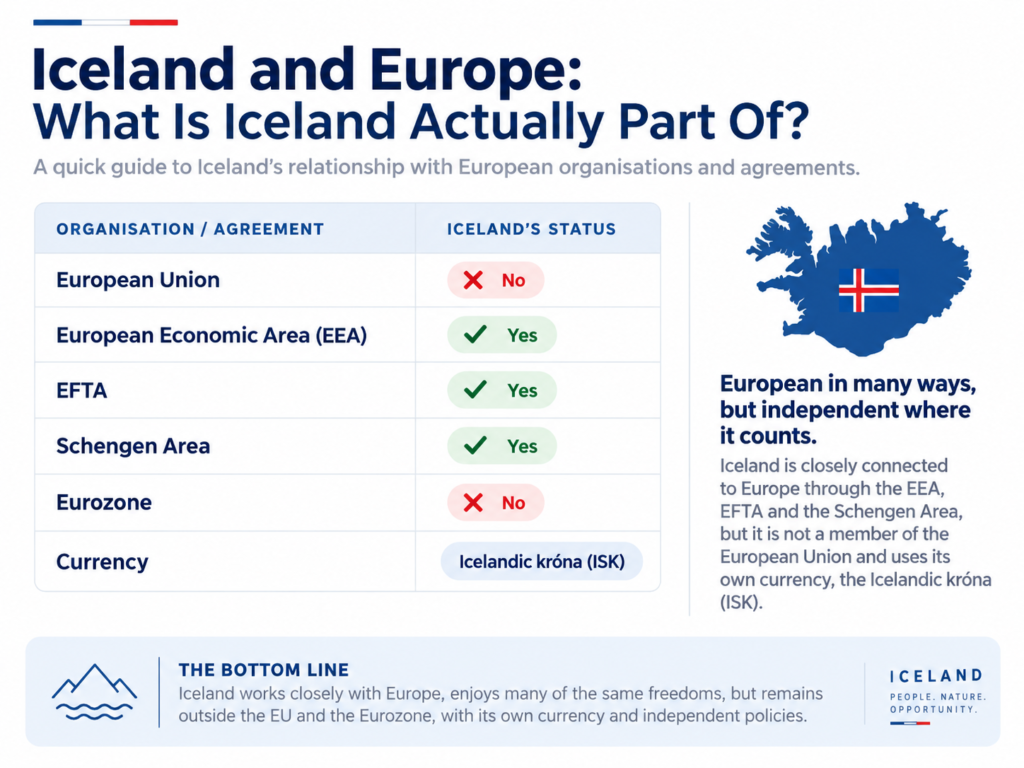
Iceland remains closely connected to Europe through the European Economic Area (EEA), European Free Trade Association (EFTA) and Schengen Area. Those arrangements matter much more to someone planning a move today than the referendum itself.
Who’s this for?
This guide is for anyone trying to understand what Iceland’s relationship with Europe means in practical terms before moving there.
That includes EU/EEA citizens wondering whether they can live and work in Iceland, Nordic citizens, people moving from the UK after Brexit, non-EEA citizens from countries such as the US and Canada, and people joining a partner or family member in Iceland.
It’s also for anyone understandably confused by the difference between the EU, EEA, EFTA and Schengen.
The focus here is practical rather than political: what does Iceland’s status actually mean for your move?
At a glance
1. Is Iceland in the European Union?
No. Iceland is not a member of the European Union.
Iceland applied for EU membership in July 2009. The EU agreed to open accession negotiations in 2010, but Iceland put those negotiations on hold after a change of government in 2013.
In March 2015, the Icelandic government asked the EU not to regard Iceland as a candidate country for membership.
The European Commission’s Iceland page provides the official timeline of Iceland’s application and accession negotiations.
The important point for anyone considering a move is that being outside the EU does not mean Iceland sits outside the wider European system.
Iceland is deeply integrated with the EU through the EEA and also participates in EFTA and Schengen.
That is why, for example, an Irish or German citizen can have extensive rights to live and work in Iceland even though Iceland itself is not an EU member.
2. How is Iceland connected to the EU?
The most important arrangement for anyone thinking about moving is the European Economic Area.
Iceland has been part of the EEA since 1994. The agreement links Iceland, Norway and Liechtenstein with the EU’s internal market and covers the free movement of people, goods, services and capital.
For movers, free movement of people is the key part.
According to EFTA’s official guidance on free movement of persons, EU citizens have the right to work and reside in EEA EFTA states such as Iceland, subject to the applicable conditions. Icelandic citizens have corresponding rights across the EU/EEA.
Students, pensioners and certain family members can also have residence rights under the EEA framework, again subject to conditions.
Iceland is also a member of EFTA – the European Free Trade Association – and participates in the Schengen Area.
These arrangements are easy to mix up.
The EEA is particularly important when considering your rights to live and work in Iceland.
Schengen is primarily concerned with borders and travel between participating countries.
So Iceland can be outside the EU while still being closely integrated with much of Europe.
3. What happened in Iceland’s 2026 EU referendum?
The referendum asked whether Iceland should resume accession negotiations with the European Union.
The count announced following the vote recorded 118,040 No votes and 105,339 Yes votes, with turnout of 82.6%
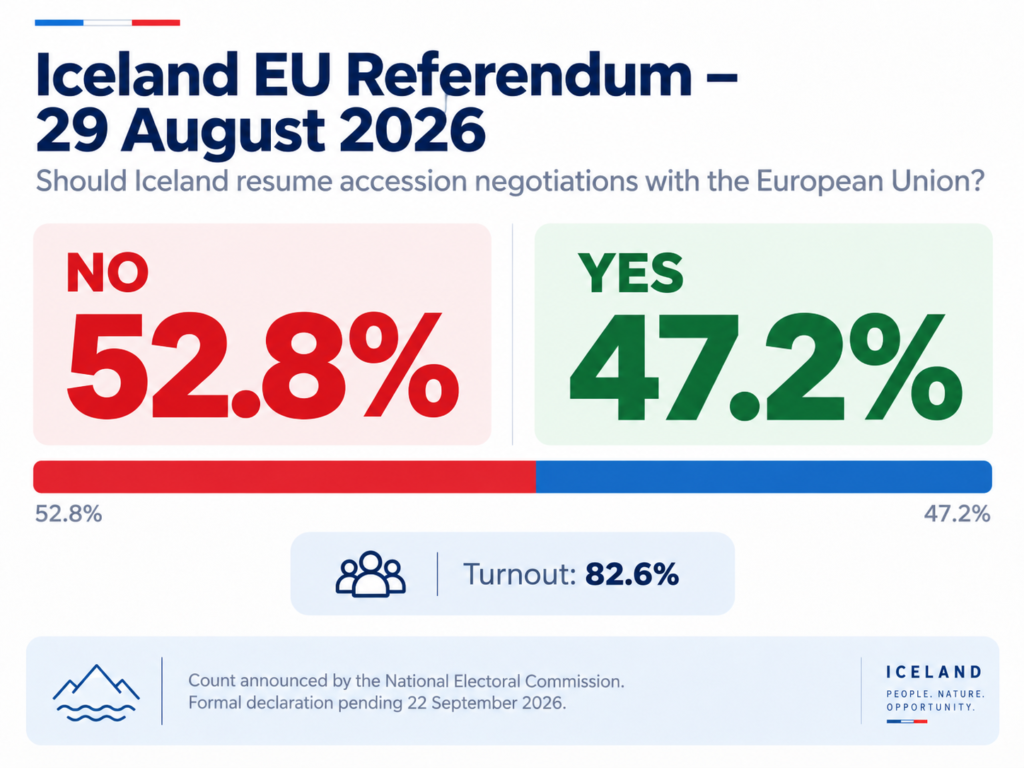
These are the figures published by the National Electoral Commission following the count.
The Commission is scheduled to meet at 14:00 on 22 September to rule on disputed ballots and formally announce the result. You can see the National Electoral Commission’s notice about the 22 September meeting here.
This distinction is important:
It was not a referendum on EU membership itself.
A Yes vote would not have made Iceland an EU member. It would have restarted accession negotiations.
Those negotiations would have dealt with the conditions under which Iceland could potentially join. Membership would have required further political steps.
Following the referendum result, the Government of Iceland confirmed that it would not resume EU membership negotiations.
So, for the current government at least, the accession process remains on hold.
4. What were the main arguments around the referendum?
The campaign revived arguments that have shaped Iceland’s relationship with the European Union for years.
One of the biggest was sovereignty and control over fisheries.
Fishing has an economic and political importance in Iceland that goes well beyond its share of everyday employment. Control over fishing waters and quotas is closely tied to Iceland’s history and national independence, and potential participation in the EU’s Common Fisheries Policy has long been one of the most sensitive issues surrounding membership.
Opponents of restarting negotiations also questioned whether Iceland should transfer more decision-making to EU institutions when the country already receives substantial access to the European single market through the EEA.
Supporters argued that restarting talks would allow Iceland to explore whether closer EU integration could provide greater economic stability and international cooperation, while potentially reopening a longer-term route towards adopting the euro.
That leaves Iceland with an unusual question:
If it already has extensive access to Europe through the EEA, what additional advantages would full EU membership provide – and what additional obligations would come with it?
The 2026 result suggests that, for now, a narrow majority of voters were not persuaded that reopening negotiations was the right next step.
5. Does the referendum change your ability to move to Iceland?
In most cases, no.
The referendum did not change Iceland’s membership of the EEA.
It did not take Iceland out of Schengen.
It did not end EEA free-movement rights.
And it did not create a new residence-permit system for people coming from outside the EEA.
Your route to Iceland therefore still depends primarily on your nationality, your circumstances and why you are moving – not on the referendum result.
6. Moving to Iceland from the EU/EEA
If you’re Irish, German, French, Spanish, Dutch or another EU/EEA citizen, Iceland does not need to be an EU member for you to benefit from EEA free movement.
EU citizens have rights to work and reside in Iceland under the EEA framework, subject to the relevant conditions.
That does not mean there is no administration involved, and the precise registration requirements depend on how long you intend to stay and your circumstances.
Registers Iceland’s guidance for EEA/EFTA citizens states that EEA/EFTA foreign nationals staying in Iceland for longer than three months must register with Registers Iceland. The registration includes legal domicile and an Icelandic ID number.
General Icelandic guidance also states that people planning to stay for six months or longer must register a legal domicile. You can read the official legal-domicile guidance here.
There are specific provisions for some circumstances, including EEA/EFTA citizens looking for work, so always check the latest official guidance for the situation that applies to you.
Your registration can also involve one of the most important numbers you’ll acquire after moving to Iceland: your kennitala, or Icelandic national ID number.
If you’re planning a long-term move, our Kennitala: Complete Guide to Iceland’s ID Number explains what it is, why you need one and how the process works.
7. Moving to Iceland from another Nordic country
Nordic citizens have a separate administrative route.
If you’re a citizen of Denmark, Finland, Norway or Sweden and are moving to Iceland from another Nordic country, you use the Nordic population-registration system rather than the standard EEA registration process.
Registers Iceland’s Nordic moving guidance requires people transferring their legal domicile from another Nordic country to complete the registration in person. A change of address should be registered within seven days of arrival.
So if you’re moving from another Nordic country, check the specific Nordic route rather than assuming the general EEA process applies.
8. Moving from the UK, US, Canada or another non-EEA country
The position is different for people who do not have EEA free-movement rights.
Non-EEA/EFTA citizens who want to reside in Iceland for longer than 90 days generally need an appropriate residence permit. Iceland’s official entry guidance explains the rules applying to people entering from outside the EEA/EFTA.
The correct permit will depend on why you’re moving – for example, employment, study or family circumstances.
British citizens should pay particular attention to the post-Brexit rules.
UK nationals who already had residence rights in Iceland before 1 January 2021 can retain rights under the Brexit arrangements as long as the relevant conditions continue to be met.
British citizens moving to Iceland now generally need a residence permit for stays longer than 90 days, in the same way as other non-EEA/EFTA citizens.
The Directorate of Immigration’s guidance for UK nationals explains both the protected pre-Brexit position and the rules applying to British citizens moving to Iceland now.
The 2026 referendum did not change those rules.
If you’re unsure whether you need to have employment lined up before moving, read our Can You Move to Iceland Without a Job? guide.
9. What if your partner or family member is an EU/EEA citizen?
Your nationality alone does not always determine your route.
If you’re from outside the EEA/EFTA but are an immediate family member of an EEA/EFTA citizen living in Iceland, you may have residence rights derived from that relationship.
This can apply to spouses or qualifying cohabiting partners, children and grandchildren under 21 or who are dependent, and certain dependent parents or grandparents.
Non-EEA/EFTA family members intending to stay longer than three months generally need to apply for a residence card.
The Directorate of Immigration’s family-member guidance explains who can qualify and when a residence card is required.
That can put you in a very different position from another non-EEA citizen moving independently.
Check the family-member route before assuming you need a standard Icelandic residence permit.
10. Could Iceland still join the EU in the future?
Yes – theoretically.
Following the August 2026 referendum, the current Icelandic government has said it will not resume accession negotiations with the European Union.
But it would be too strong to say Iceland has rejected EU membership forever.
The referendum was advisory and the announced result – 52.8% to 47.2% – was relatively close.
Governments change. Public opinion changes. Economic and geopolitical circumstances change.
A future Icelandic government could therefore revisit the issue.
Even restarting negotiations would not automatically make Iceland an EU member. Accession would require a much longer political and negotiating process.
For someone planning a move today, though, that is largely academic.
Plan around the system Iceland has now rather than a possible future EU membership.
11. What does Iceland’s EU referendum mean for you?
For most people planning a move, the easiest way to understand the result is by looking at your own nationality and circumstances.
If you’re an EU/EEA citizen
Essentially nothing has changed.
Iceland remains in the EEA and EEA free-movement rights continue.
You can still live and work in Iceland under the EEA framework, subject to the relevant conditions and registration requirements.
If you’re a Nordic citizen
Nothing has changed.
Nordic citizens continue to use the specific Nordic population-registration arrangements when moving to Iceland.
If you’re a British citizen
The referendum did not change the post-Brexit rules.
If you are moving to Iceland now, you will generally need to use Iceland’s residence-permit system for stays longer than 90 days unless another specific right or exemption applies.
People protected by the Brexit arrangements because they were already resident before 1 January 2021 remain in a different position.
If you’re from the US, Canada or another non-EEA country
Nothing has changed because of the referendum.
You will generally still need the appropriate Icelandic residence permit if you plan to live in the country for longer than 90 days.
Your route will depend on factors such as work, study or family.
If you’re joining an EEA/EFTA partner or family member
You may still have rights through your relationship with that person.
Eligible non-EEA/EFTA family members can have derived residence rights under the EEA framework and may need to apply for a residence card rather than a standard residence permit.
The bottom line
The referendum changed the political outlook for Iceland’s potential EU membership.
It did not change the basic system for moving to Iceland.
Iceland remains outside the European Union but inside the EEA and EFTA, and it continues to participate in Schengen.
EU/EEA citizens therefore continue to benefit from extensive free-movement rights. Nordic citizens retain their specific registration arrangements. Most people coming from outside the EEA/EFTA still need to use Iceland’s residence-permit system.
And Iceland still uses the Icelandic króna, not the euro.
What you should do next depends on your passport and circumstances – not on the referendum.
What to read next
If you’re actively considering a move, two practical questions usually come next.
If you’re unsure whether you need employment lined up before relocating, read Can You Move to Iceland Without a Job? It explains how the answer changes depending on your nationality and circumstances.
Then read our Kennitala: Complete Guide to Iceland’s ID Number to understand one of the most important pieces of administration you’ll encounter after moving.
As Moving2Iceland expands, we’ll also be adding detailed guides covering residency routes, housing, jobs, banking, healthcare and your first weeks in Iceland.
FAQs
Is Iceland in the EU?
No. Iceland is not a member of the European Union.
It is, however, part of the EEA and EFTA and participates in the Schengen Area.
Did Iceland vote to leave the EU in 2026?
No.
Iceland was not an EU member. The referendum asked whether Iceland should resume negotiations that could potentially lead towards EU membership.
What was the Iceland EU referendum result?
The count announced after the 29 August referendum was 52.8% No and 47.2% Yes, with turnout of 82.6%.
The National Electoral Commission is due to formally declare the result on 22 September after ruling on disputed ballots.
Did Iceland restart EU membership negotiations?
No.
Following the referendum result, the Icelandic government said it would not resume EU membership negotiations.
Did the referendum change the rules for moving to Iceland?
No.
The referendum did not change Iceland’s EEA membership, EEA free-movement rights, Schengen participation or the basic residence-permit system for non-EEA/EFTA citizens.
Can EU citizens move to Iceland?
Yes.
EU citizens benefit from EEA free-movement rights in Iceland, subject to applicable conditions and registration requirements.
Can Irish citizens move to Iceland?
Yes.
Irish citizens benefit from EEA free-movement rights in Iceland and are covered by Registers Iceland’s EEA/EFTA registration process.
Is Iceland in the EEA?
Yes.
Iceland has been part of the European Economic Area since 1994.
Is Iceland in Schengen?
Yes.
Iceland participates in the Schengen Area despite not being an EU member.
Does Iceland use the euro?
No.
Iceland uses the Icelandic króna, usually abbreviated ISK.
Would Iceland joining the EU make it much easier for EU citizens to move there?
Probably not as dramatically as you might assume.
EU citizens already have extensive rights to work and reside in Iceland through the EEA.
Full EU membership could change other aspects of Iceland’s relationship with Europe, but freedom of movement already applies through the EEA framework.
Will Iceland join the EU?
Not in the immediate future.
Following the August 2026 referendum, the current Icelandic government has said it will not resume accession negotiations.
But the vote was advisory and relatively close, so a future government could revisit the issue if political or economic circumstances change.
Original sources
For the referendum itself
- National Electoral Commission – Results of counting in the referendum held 29 August 2026
- National Electoral Commission – Public referendum 29 August 2026 and advisory status
- National Electoral Commission – 22 September meeting to formally declare the result
- Government of Iceland – Referendum outcome: Iceland not to resume accession negotiations with the European Union
For Iceland’s relationship with the EU and EEA
- European Commission – Iceland: EU accession history and current status
- European Free Trade Association – Free Movement of Persons
For moving and residence rules
- Registers Iceland – Registration of EEA/EFTA citizens
- Ísland.is – Setting up legal domicile as an immigrant
- Registers Iceland – Moving from another Nordic country to Iceland
- Directorate of Immigration – Entry requirements for non-EEA/EFTA citizens
- Directorate of Immigration – Residence rights of UK nationals and their family members
- Directorate of Immigration – Residence rights of family members of EEA/EFTA citizens
Immigration and registration requirements can change. Always check the latest Icelandic government guidance before applying or moving.