


Iceland has long had a reputation for high employment, labour shortages and strong demand for international workers.
But the labour market has changed.
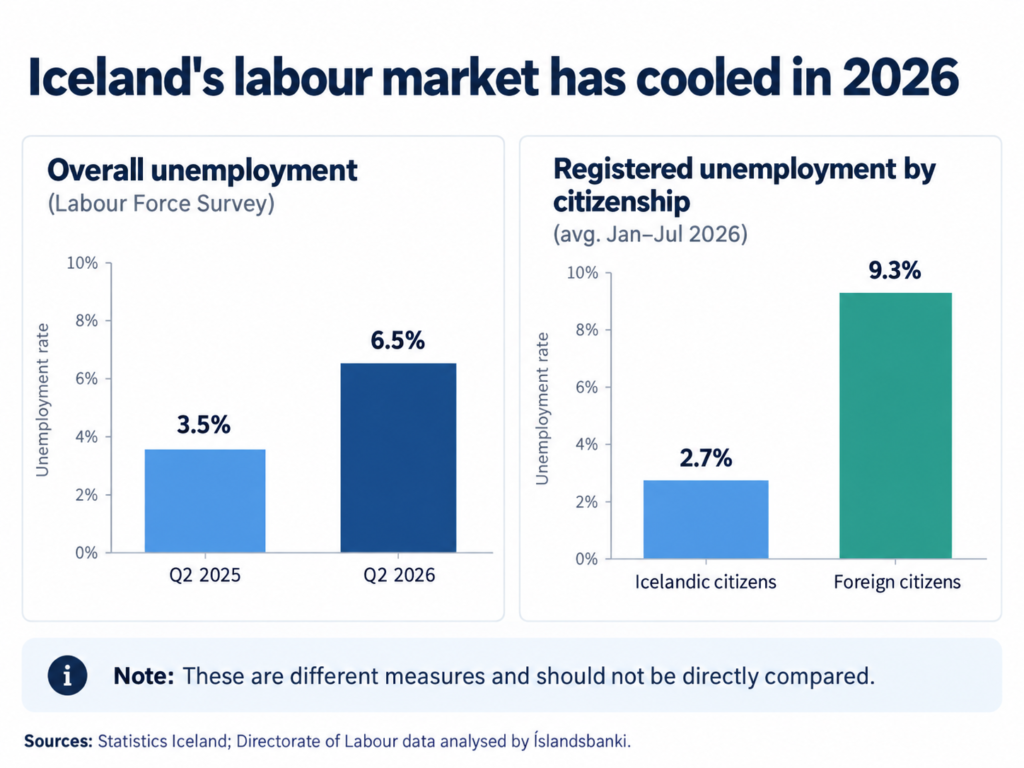
In Q2 2026, Iceland’s unemployment rate rose to 6.5%, up from 3.5% a year earlier. Separate registered-unemployment data also shows a much tougher picture for foreign citizens than Icelandic citizens.
So if you’re thinking about moving to Iceland for work, how worried should you be?
The answer depends heavily on your nationality, occupation, qualifications and Icelandic language skills. But the latest figures suggest one thing quite clearly:
Moving to Iceland first and assuming you’ll quickly find a job has become a riskier strategy than it was a few years ago.
Key takeaways
- Overall unemployment reached 6.5% in Q2 2026, according to Statistics Iceland’s Labour Force Survey – up from 3.5% in Q2 2025.
- Registered unemployment averaged 9.3% among foreign citizens from January to July 2026, compared with 2.7% among Icelandic citizens.
- Job vacancies have also fallen, confirming that Iceland’s labour market has cooled.
- Some sectors still face recruitment shortages, but that does not mean jobs are easy to secure across the economy.
- Your right to work, occupation, qualifications and level of Icelandic can all materially affect your chances of finding employment.
Who is this guide for?
This guide is for people considering moving to Iceland for work, including:
- EU/EEA citizens considering relocating before finding a job
- non-EEA applicants researching work and residence options
- newcomers already in Iceland and looking for employment
It focuses specifically on current labour-market conditions rather than providing a complete guide to careers, salaries or finding a job in Iceland.
Related: Can You Move to Iceland Without a Job?
What do the latest unemployment figures show?
The clearest message from the latest data is that Iceland’s labour market has weakened significantly.
Statistics Iceland estimated that 15,400 people were unemployed and actively seeking work during Q2 2026, equivalent to 6.5% of the labour force aged 16–74.
A year earlier, unemployment stood at 3.5%.
And unemployment is only part of the picture.
The number of jobs available has also fallen.
According to Statistics Iceland’s Job Vacancies Survey, there were approximately 3,540 vacant jobs in Q2 2026, producing a vacancy rate of 1.4%.
Compared with Q2 2025, Iceland had:
- 1,870 fewer job vacancies
- a vacancy rate 0.8 percentage points lower
The Central Bank of Iceland has similarly described the labour market as continuing to soften, with fewer vacancies relative to the number of people looking for work.
So this is not simply a statistical rise in unemployment.
There are also materially fewer jobs waiting to be filled.
Alt text: Chart showing Iceland’s unemployment rate rising from 3.5% in Q2 2025 to 6.5% in Q2 2026, with registered unemployment higher among foreign citizens than Icelandic citizens.
Is unemployment really higher among foreigners in Iceland?
Yes – although the figures need to be interpreted carefully.
An Íslandsbanki analysis of Directorate of Labour data found that, between January and July 2026, registered unemployment averaged:
9.3% among foreign citizens
compared with:
2.7% among Icelandic citizens.
That is a substantial gap.
However, there are two important qualifications.
First, a foreign citizen is not necessarily a recent immigrant.
Someone may have lived in Iceland for many years, speak fluent Icelandic and hold permanent residence while retaining another citizenship.
Second, these figures come from different unemployment measures.
The 9.3% figure is based on registered unemployment, while Iceland’s national 6.5% unemployment figure comes from Statistics Iceland’s Labour Force Survey.
They should therefore not be directly compared as though they are the same dataset.
What the evidence does establish is that there is a significant employment gap between foreign and Icelandic citizens.
What the numbers do not establish on their own is exactly why that gap exists.
The explanation is likely to involve several factors.
Language can narrow the jobs available
You can work in Iceland without speaking Icelandic.
Many people do.
English is widely spoken, and some international businesses, tourism operators, hospitality employers and specialist workplaces operate partly or predominantly in English.
But that does not mean Icelandic is irrelevant to your job prospects.
EURES notes that most Icelandic employers advertise vacancies in Icelandic unless the role is specifically listed through EURES, where an English version is required.
That means an English-only job search automatically excludes part of the labour market.
For many public-facing, professional and locally focused roles, Icelandic can be especially important.
So the useful question is not simply:
Can I live in Iceland speaking English?
It is:
Can I realistically build a career in my particular field without Icelandic?
Those are not necessarily the same thing.
Your industry matters
“Foreign workers” are not one labour-market group. Your prospects depend heavily on:
- your occupation
- qualifications
- previous experience
- language ability
- where in Iceland you are prepared to live
Foreign workers have historically played an important role in industries including tourism and accommodation.
At the same time, some occupations continue to experience recruitment difficulties.
That is why Iceland can have rising unemployment and labour shortages at the same time.
The unemployed people available for work do not necessarily have the qualifications, skills, language ability or location required for the jobs employers are struggling to fill.
Qualifications may need to be recognised
If you qualified outside Iceland, do not assume your qualifications will automatically allow you to work in the same occupation.
Some regulated professions require formal recognition, licensing or registration before you can legally work in Iceland. This is particularly important in fields such as healthcare and other regulated professional occupations. Check the requirements for your profession before you move.
Are there still jobs in demand in Iceland?
Yes.
But shortages are concentrated in particular occupations rather than spread evenly across the economy.
Healthcare is one example.
Iceland continues to recruit internationally into parts of its healthcare system, but overseas professionals may need to meet qualification-recognition, licensing and language requirements.

Caption: Healthcare is one area where Iceland continues to experience recruitment needs, although professional recognition and language requirements may apply. (Image: Moving2Iceland / AI-generated)
This is why you should be cautious about generic articles claiming Iceland is “desperate for foreign workers” across a long list of industries.
The overall number of vacancies is falling.
A shortage in one profession does not mean Iceland has a general shortage of workers.
And an occupation experiencing shortages does not automatically mean you will get a job – or qualify for permission to live and work in Iceland.
Can you find work in Iceland without speaking Icelandic?
Yes – but your options are narrower.
You are more likely to encounter English-speaking workplaces in areas such as:
- tourism and hospitality
- international companies
- some technology and specialist roles
- workplaces specifically recruiting internationally
But Icelandic can make a substantial difference to your longer-term employment prospects.
The more locally focused or public-facing the role, the more likely language will matter.
That does not mean you need fluent Icelandic before arriving. It does mean that learning Icelandic can materially expand the number and type of jobs available to you over time.
Can EU/EEA citizens move to Iceland without a job?
EU/EEA and EFTA citizens have considerably more flexibility than most non-EEA nationals.
They are generally exempt from Iceland’s work-permit requirement, although residence and registration requirements still apply depending on their circumstances and how long they remain in the country.
So for many EU/EEA citizens, moving to Iceland before securing employment can be legally possible.
But legally possible and financially sensible are not the same thing.
In the current labour market, arriving without work means accepting the possibility that your job search could take longer than expected.
Meanwhile, your costs begin immediately:
- temporary accommodation
- rent and deposits
- food
- transport
- utilities
- other day-to-day expenses
If you are considering doing this, make sure you have enough savings to withstand a longer-than-expected job search.
Related: Can You Move to Iceland Without a Job?
What about non-EU/EEA citizens?
The position is significantly more restrictive for most people from outside the EEA/EFTA.
Non-EEA nationals generally require permission to work in Iceland.
Work-based residence routes are linked to specific employment and include categories such as work requiring expert knowledge and, in more limited circumstances, labour shortages.
In practice, most non-EEA applicants using a work-based route will need an appropriate job offer or employment contract and must qualify for the relevant residence and work permission.
A shortage-of-labour permit is not simply available to anyone who finds an advertised vacancy.
It is a specific immigration route with its own eligibility requirements.
Responsibility for processing work permits moved from the Directorate of Labour to the Directorate of Immigration in July 2026.
For most non-EEA movers, securing an appropriate employment route before relocating to Iceland is therefore particularly important.
What should you do before moving to Iceland for work?
The latest unemployment figures do not mean you should abandon plans to work in Iceland.
They do mean you should test those plans against the real labour market before committing to a move.
1. Confirm your right to work
Understand the rules that apply to your nationality and residence status.
EU/EEA citizens and non-EEA citizens face very different immigration and employment requirements.
2. Research actual vacancies
Search for jobs in your own profession.
Do not base a relocation decision on generic articles listing supposedly “in-demand” jobs.
Look at what employers are hiring for right now.
3. Check the language requirements
Look at real advertisements in your field.
How many require Icelandic?
How many accept English?
That will tell you considerably more than general statements about Icelanders speaking excellent English.
4. Verify your qualifications
If you work in a regulated profession, establish whether your existing qualifications are recognised and whether you need licensing or professional registration.
5. Apply before relocating where possible
Even if you have the right to move to Iceland without a job, applying from abroad gives you valuable information about the market.
Are employers responding?
Are you reaching interview stage?
Are there enough appropriate vacancies?
Test the assumption before spending thousands of euro on a move.
6. Compare salary with housing and living costs
Getting a job is only part of the equation.
You also need to establish whether the salary realistically supports the life you expect to have in Iceland.
Housing is particularly important.
A job offer that looks attractive in isolation may look very different once rent and other living costs are included.
7. Keep a financial buffer
Plan for the possibility that finding suitable employment takes longer than expected.
Treat “I’ll find something when I get there” as a risk – not a relocation strategy.
So, is it harder for foreigners to find work in Iceland in 2026?
The latest evidence suggests that it is a more difficult labour market than it was a year ago, and foreign citizens are experiencing substantially higher registered unemployment than Icelandic citizens.
But that does not mean there are no opportunities.
Iceland still employs large numbers of international workers, and employers in some occupations continue to recruit.
Your individual prospects will depend far more on your specific circumstances than on the national unemployment rate alone.
Someone with:
- an occupation experiencing shortages
- recognised qualifications
- relevant experience
- Icelandic language ability
- or employment already secured
is in a very different position from someone arriving without a job, without Icelandic and hoping to find general work after they arrive.
Bottom line
Iceland can still be a realistic place to move for work.
But the calculation has changed.
Unemployment has risen. Vacancies have fallen. And registered unemployment is substantially higher among foreign citizens than Icelandic citizens.
That does not mean foreigners should not move to Iceland.
It means you should not assume employment will simply sort itself out once you arrive.
Research your occupation. Understand your legal route. Look at real vacancies. Check whether your qualifications are recognised. Compare likely salaries with housing costs.
And wherever possible, test the Icelandic job market before you make the move.
Read next
Can You Move to Iceland Without a Job?
What EU/EEA and non-EEA citizens need to know before relocating without employment.
How to Get a Kennitala in Iceland
When you need an Icelandic identification number, who can get one and how the process works.
Is Iceland in the EU? What the 2026 Referendum Means for Moving to Iceland
What Iceland’s relationship with the EU, EEA, EFTA and Schengen means for people planning to move there.
Original sources
- Statistics Iceland – The Icelandic Labour Market in the Second Quarter of 2026
- Statistics Iceland – Job Vacancies, Second Quarter 2026
- Central Bank of Iceland – Monetary Bulletin 2026/3
- Ísland.is / Directorate of Immigration – Apply for a Work Permit
- Ísland.is / Directorate of Immigration – Residence Permit Based on Work
- Directorate of Immigration – New Residence and Work Permit Rules Take Effect
- EURES – Living and Working Conditions in Iceland
- Íslandsbanki – Labour Market in a New Environment